Introduction to Ayurveda
- Sarah Hardy
- Feb 24, 2024
- 9 min read

Updated: Mar 5, 2024
Discover Ayurveda - an ancient system that seeks to balance the mind, body, and spirit to promote health. Often called the "sister science" of yoga, Ayurveda is a holistic lifestyle that reconnects individuals to the Earth and its natural cycles. The term Ayurveda comes from the Sanskrit words "Ayus," which means longevity, and "Veda," which means knowledge or science. In essence, Ayurveda can be translated as the Science of Longevity or Knowledge of Life.

The practice of Ayurveda helps us become more mindful of our daily habits and teaches us how to heal and maintain our quality of life. Ayurvedic practices include eating according to your body type, using food as medicine, yoga, breathing exercises, meditation, and daily self-care routines. This knowledge was passed down orally from teacher to student for thousands of years through chants, sutras, and poetic phrases. Ayurveda was first recorded in the Vedas or "books of wisdom" and is considered the oldest written knowledge originating from India.
Ayurveda is a holistic approach to health that aims to balance mental, physical, and spiritual well-being. It recognizes that every living being is unique, with individual qualities, emotions, and bodies made up of the elements that need harmony. Ayurveda offers accessible ways to achieve balance through food, exercise, rest, meditation, and lifestyle practices. By adopting these practices, individuals can bring their health back to balance and maintain it over time, ensuring a high quality of life. Individual qual up of elements
The Path to Longevity
According to Ayurveda, health isn't just determined by physical wellness but by mental, emotional, spiritual & energetic well-being. Health in Sanskrit derives from the word "svastha", "sva' meaning one's own self & "stha" meaning to be situated or existing in. In other translations, "svastha" means to rely on one's self, which is simply so powerful to think about. Health means to rely on oneself, to exist in one's body & to be content. Ayurveda does just that: it teaches you how to take care of yourself to achieve a state of bliss or health.
In Ayurveda, health is defined as the state in which the body, mind & soul are harmoniously experiencing a feeling of wellness & bliss. Building a path to health & wellness can be extremely simple! First, consider getting enough sleep to allow your mind & body to rest, recover & rejuvenate. Take time out of your day to focus on your breath, assess your feelings (without judgment), eat healthy & nutritious food, drink enough water & exercise. After you begin to implement these things into your daily schedule, you'll begin to see a major difference in your energy, mood & overall health.

Pillars of Health
Prioritize rest
Focus on your breath
Acknowledge emotions without judgment
Use food as medicine
Hydrate
Add remedies & supplements when needed
Exercise & move your body
Seek outside support
Building a Foundation
The key to wellness and healing is the knowledge that health is not a "one size fits all." Each person is unique & each remedy should acknowledge the individual qualities, the situation, & geography. Each person has a framework that is specific to them, & choices that differ from you on an elemental level can create imbalances. When imbalances are not acknowledged, dis-ease may develop & could lead to further health issues. Symptoms can serve as a wake-up call to make shifts in our lifestyle, behavior & routines to allow us to return to a state of balance & health.
Ayurveda is based on the Pancha Maha Bhutas or the 5 great elements: ether, air, fire, water & Earth. The elements are the basic building blocks of the universe, including every plant, animal, person & star. These elements break down into the 3 Doshas or energetic bodies with different gunas or qualities that allow us to recognize our unique mind-body types to learn strengths & weaknesses for each individual & provide a guide to bring the mind & body back to balance. Understanding the elements will allow us to acknowledge the aspects of the universe outside & within our bodies so we can learn to live in harmony with the elements.
Each element has its own characteristics & properties. Ether or space represents emptiness, consciousness & intuition. Air represents movement, expansion & communication. Fire represents energy, passion & transformation. Water represents fluidity, adaptability & change. Lastly, Earth represents solidity, stability & grounding.
The 20 Qualities
A doshic imbalance or vikriti can manifest symptoms & give us a feeling of "something is not right" & progress to an illness or even a disease. To prevent this Ayurveda has an easy way to aid you on your journey to finding balance & knowing what to do to get there. Its as simple as doing the opposite as the quality you're feeling.
Heavy / Light
Slow (dull) / Quick (sharp, penetrating)
Cold / Hot
Smooth (slimy) / Rough
Solid (dense) / Liquid
Soft / Hard
Stable (static) / Moving (mobile, spreading)
Subtle / Large (gross, fleshy smell)
Clear / Cloudy (thick)
Oily / Dry
Seasonal Care
The 5 great elements or "Pancha Maha Bhutas" can broken down into the 4 seasons of winter, spring, summer & fall which represent the elements through nature's cycles as well as the 4 directions. These seasonal changes allows us to understand how to find balance in our lives by giving remedies to support the changes in the elements, energy & natural cycles.
Start by looking at the qualities of the seasons and cycles allowing yourself to become familiar with how each equinox or solstice brings a new focus, new goals, self-care routines, foods, herbs & spices as well as yoga practices. Look at the goals, no matter where we are in the year you can always hibernate & meditate on what you want to start first and then slowly plant seeds by adding these practices to your daily life. As you allow yourself to grow and blossom make sure to take a break, breathe & assess what is working in your plan & what is not working then make changes accordingly. Finally, after you've reached your goal make sure you celebrate your success and reward your self! Slowly you can begin the cycle again returning to a meditative state & allowing the ideas to come to you while following along with the self-care routines, yoga practices & food recommendations.

Understanding the qualities & changes of each season can help you reduce any symptoms that may come up. No matter what you can always come back to this guide for an easy way to take charge of your life. Following along with seasonal care will give you the tools to steer your physical & mental health to a balanced place while allowing you to switch things up every few months & live your life in harmony with the elements.
Your Body Type
Each of the 5 great elements can be found in different amounts in every person, which causes different tendencies. Think about how water flows, a mountain that stands tall & sturdy, a desert that is dry, a forest that may catch fire & then the universe full of empty space. Just like the world around us, we all share some of the same qualities, such as being easygoing & flowing like water, being grounded, having dry humor, coming off as intense & even being a little spacey.
Everyone has a unique mind-body constitution comprised of the 5 great elements that reveal strengths & weaknesses that are set at birth, called a prakruti. Prakruti means nature & is created from the balance of elements within the body generated by heredity, genetics, where you were conceived, the alignment of the planets at the time of your birth, karma & your past lives. Prakruti cannot be changed throughout your life, each individual has a primary & secondary dosha & rarely some people have an equal balance of all three Doshas.
The state of your present health is referred to as vikruti which means distorted. Vikruti is caused by childhood, lifestyle, environment, the food we eat, & how we deal with emotions. It's natural to get out of balance, the goal is to get back to our Prakriti. Remember, health is not about being perfect its the ability to face what is, moment to moment & make changes accordingly.
According to Ayurveda, there are 3 primary energetic life forces in the body created from the elements called Doshas; Vata, Pitta & Kapha. Dosha means "that which has a fault" or "that which can cause problems", which confirms that we are not meant to be perfect but rather be conscious. Every day we must be conscious of how we feel physically & mentally in order to make adjustments to bring ourselves back to a state of balance. The Doshas show up in characteristics, physical attributes, habits, emotional patterns & even the way you digest. Your Dosha is also referred to as your prakruti which is assigned at birth. Everyone has every element within the body, but some are more dominant than others. Knowing which elements are more dominant will allow you to recognize your specific needs, what causes you to feel unbalanced & how to bring yourself back to balance with remedies.


Each person has a dominant dosha, as well as each bodily tissue, organ & emotion that identifies its function. Paying attention to symptoms allows us to consider what's needs attention in our bodies & how to prevent dis-ease.
This Dosha quiz will allow you to learn your prakruti & give you the opportunity to understand your unique mind-body constitution so you'll be able to know yourself better, acknowledge the things that interfere with your health & use tools to bring you back to harmony. Remember that this quiz is an assessment of your most natural state. Answer the questions using your physical & emotional baseline. Its ok if not every single thing applies to you but pick the answer that fits the best.
Your constitution, Prakriti, or Ayurvedic body type, is established at conception and remains constant throughout your lifetime. It represents your natural state of balance and gives a guide fo perfect health.
Dual types are the most common constitutions, meaning your highest score is your primary Dosha, the second highest is your secondary & the lowest is tertiary. Let's say your Vata dominant & Pitta secondary: Vata would be the greatest group of elements within the body, making you prone to feeling Vata imbalances; Pitta would be the second greatest, aiding in the imbalances & Kapha would be the least likely to cause imbalances.
Rare types are constitutions with one dominant Dosha & two doshas that are secondary meaning your greatly influences by one dosha while the others are generally balanced. Lastly, another rare Dosha is tri-doshic, which means you'll feel imbalances from all the elements but can be very healthy, strong & stable when in balance.
Ayurveda recognizes seven basic constitutional types:
Dual Types
Vata-Pitta: Vata dominate, Pitta secondary, Kapha balanced
Vata-Kapha: Vata dominate, Kapha secondary, Pitta balanced
Pitta-Kapha: Pitta dominate, Kapha secondary, Vata balanced
Pitta - Vata: Pitta dominate, Vata secondary, Kapha balanced
Kapha - Vata: Kapha dominate, Vata secondary, Pitta balanced
Kapha - Pitta: Kapha dominate, Pitta secondary, Vata balanced
Rare Types
Vata: Vata Dominate, Pitta & Kapha Secondary
Pitta: Pitta Dominate, Vata & Kapha Secondary
Kapha: Kapha Dominate, Vata & Pitta Secondary
Tri-doshic: All three doshas are equal
Balance vs Imbalance
The best way to bring yourself back to balance is to understand imbalances & how you got off the path of longevity due to disturbances & unhealthy habits. Yes, there are 20 qualities but there are 4 main qualities that show up & cause physical & emotional disturbances which we will learn first to get a grasp on how to apply these methods to our life. Hot, cold, wet & dry come from seasonal changes as well as other disturbances that life throws at us.

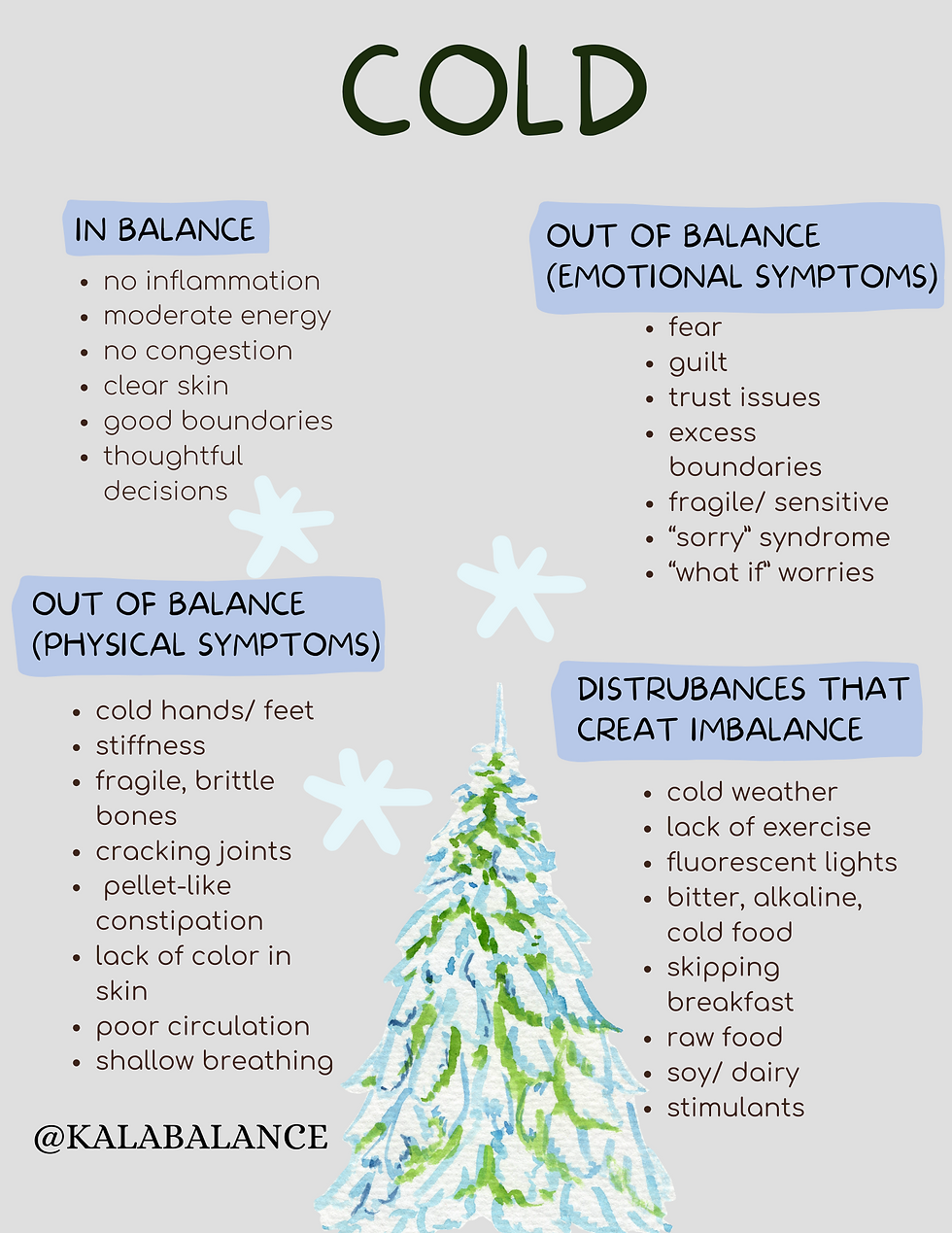


A Map to Health

The body is amazing at communicating what is required to feel its best by showing symptoms. Your symptoms are not bad or wrong! Symptoms are the body way of telling you what it needs so its your job to listen & make changes so you can heal & provide yourself with the right remedies.
If you're feeling anxious you may be dry, if your feeling sensitive you may be cold, if you're frustrated you're probably hot & if your lacking motivation or have low energy you're too wet. Understanding emotional & physical symptoms gives you a chance to make much needed changes to your daily life so acknowledging them without judgment gives you a chance to balance the elemental disturbance.
In Ayurveda, symptoms change when you do the opposite. You can treat symptoms of hot, cold, wet or dry by matching it with remedies of the opposing nature. Ayurvedic remedies range from food, spices, herbs, oils & self care tools which can either be cooling, heating, nourishing or cleansing. Learning to match your symptoms with what it needs will allow you to make changes to feel stronger, healthier & more in tune.
If you're hot, you need cooling remedies.
If you're cold, you need heating remedies.
If you're wet, you need cleansing remedies.
If you're dry, you need nourishing remedies.
It takes time to learn how to apply these changes into your life. Trust in yourself, how you feel & take the time to learn what your body needs. Remember to be patient & follow these steps regularly.

Listen
Acknowledge
Make changes


Comments